
How to prepare an annual budget for your housing society (with a sample split)
HousingMS Team · 3 Nov 2026 · 5 min read
A society budget is a promise to members: this is what running the building will cost next year, and this is what each flat will pay for it. Get it right and the maintenance charge feels fair and nobody is surprised. Get it wrong and the committee spends the year asking for special contributions. Here is a method any committee can follow, even without an accountant on board.
When to prepare it
Most societies follow the April to March financial year. Start the budget in January or February, so the committee can approve it and present it to members along with the accounts at the general body meeting. If you are also preparing for the AGM, our AGM preparation checklist covers the rest.
Step 1. Start from last year's actual spending
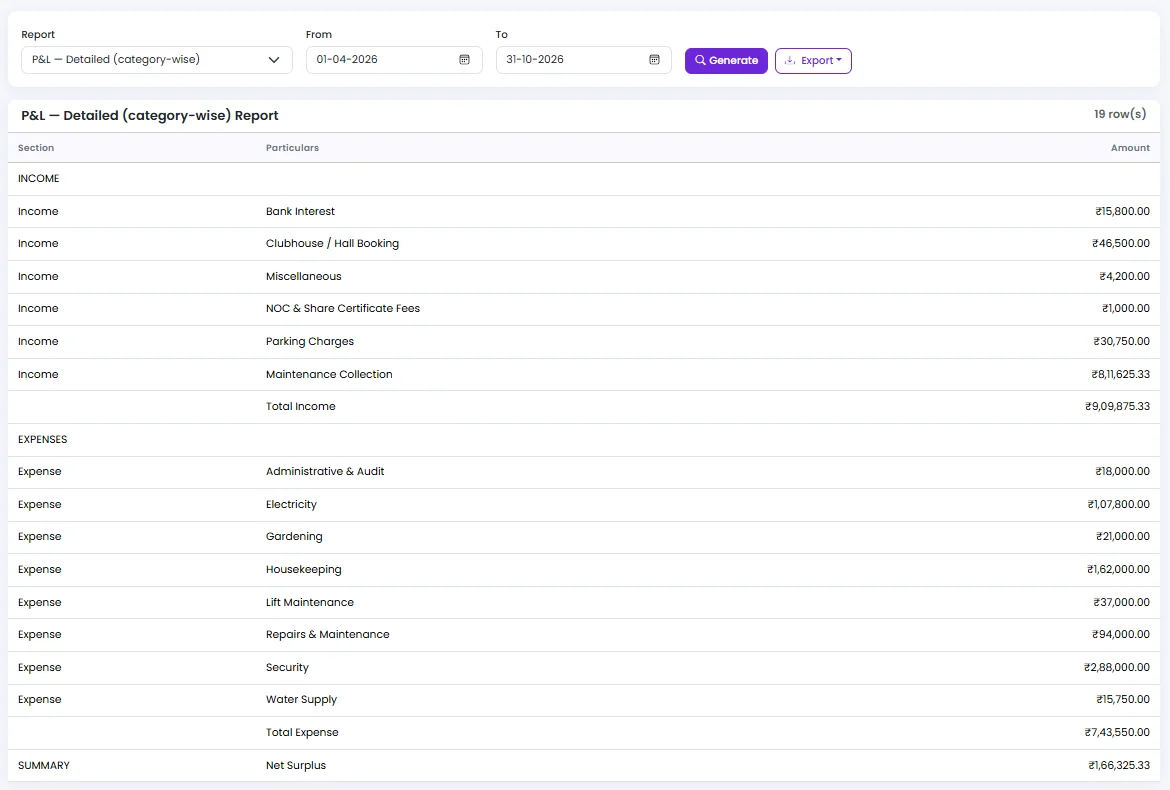
Guessing is where most budgets go wrong. Pull a category-wise profit and loss statement for the last twelve months: every income head and every expense head, with totals. In HousingMS this is Reports → P&L — Detailed (category-wise).
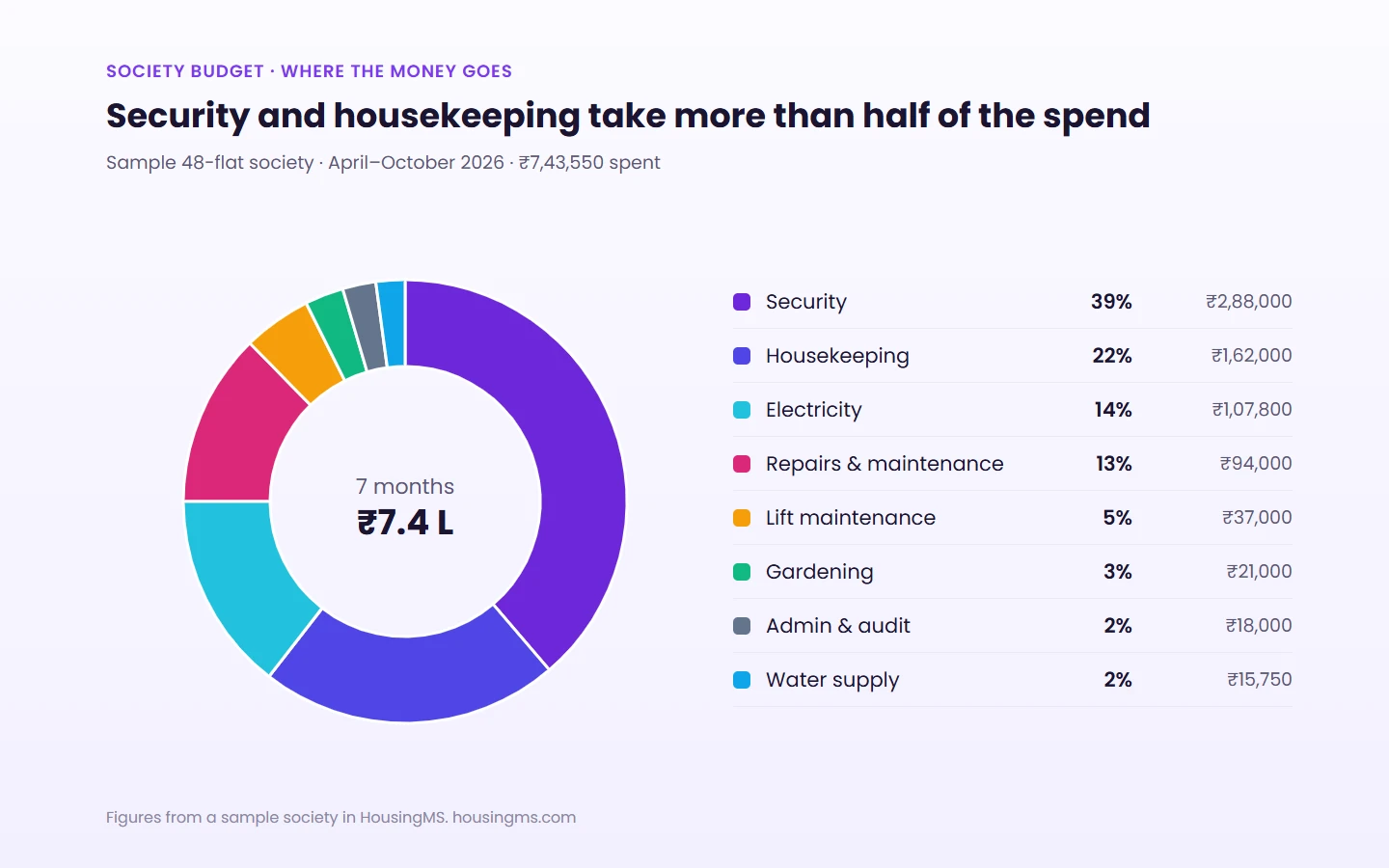
In the sample society above, seven months of spending came to ₹7.4 lakh. Security (39%) and housekeeping (22%) together took more than half, electricity for common areas took 14%, and repairs took 13%. Your society will differ, but in most buildings the staff contracts are the largest line by far.
Step 2. Adjust each line for next year
Go through the expense heads one by one:
- Contracts: security agency, housekeeping, lift AMC and gardening. Use the new contract amounts, and include any increase already agreed or expected at renewal.
- Utilities: common-area electricity, water tankers and the water bill. Start from last year and allow for tariff changes and the season, since summers often need more tankers.
- Planned repairs: waterproofing before the monsoon, painting, pump replacement, CCTV upgrades. List each job with a quotation if you have one.
- Statutory and admin: audit fee, building insurance, bank charges, stationery and the society office.
- Festivals and events: many societies keep these self-funded through separate contributions, so they don't burden the maintenance charge.
- Contingency: add 5 to 10% for the things nobody planned, such as a burst pipe or a motor failure.
Step 3. Count the other income
Maintenance is not the society's only income. Include parking charges, clubhouse or hall bookings, NOC and transfer fees, non-occupancy charges and interest on deposits. In the sample society, these brought in about ₹98,000 in seven months, money that does not have to come from the maintenance charge.
Step 4. Turn it into a maintenance charge
Subtract the other income from total budgeted expenses. What is left is what maintenance must cover. Divide it by 12 for a monthly figure, then share it among flats in the way your bye-laws require. Service charges are often shared equally per flat, while some heads are charged by carpet area.
Keep the long-term funds separate from this calculation. The sinking fund and repair fund are worked out on their own rules and added to the bill as separate lines.
Allow for late payers. If some flats regularly pay late, the society still has to pay its vendors on time. Look at last year's collection: if only about 92% of the billed amount came in on time, keep a cash buffer or plan for it rather than assuming 100%.
Step 5. Present it simply
Members do not need forty lines. Show the main heads, last year's actual, next year's budget and the change in rupees and percent. Explain any increase above 10% in one sentence each: "Security contract renewed at the new minimum wage", "Terrace waterproofing scheduled before June".
| Head | Last year actual | Next year budget | Change |
|---|---|---|---|
| Security | ₹4,94,000 | ₹5,30,000 | +7% |
| Housekeeping | ₹2,78,000 | ₹2,95,000 | +6% |
| Common electricity | ₹1,85,000 | ₹1,95,000 | +5% |
| Repairs (planned) | ₹1,60,000 | ₹2,40,000 | +50%, terrace waterproofing |
| Contingency | — | ₹60,000 | new |
Illustrative figures for a 48-flat society.
Step 6. Track it every month
A budget is only useful if someone compares it with reality. Once a month, the treasurer can run the same category-wise report for the year to date and compare each head with its budget for the same months. A line running far ahead of budget by July is much easier to fix than one discovered in March.
Frequently asked questions
Who approves the society budget?
The managing committee prepares it, and it is placed before the general body, usually at the AGM, together with any change in maintenance charges.
How much should a society keep as a reserve?
Beyond the sinking fund, many committees aim to hold two to three months of running expenses in the bank so that vendor payments are never delayed by late collections.
Can maintenance be increased mid-year?
It is better avoided. A realistic budget with a contingency line usually removes the need. If a large unplanned expense arises, follow your bye-laws and take it to the general body.
See how HousingMS keeps society accounts and reports up to date every month.